 EN
EN  ES
ES  DE
DE  FR
FR  PL
PL  IT
IT  RU
RU  PT
PT 
PADI Emergency First Response
| Service | Price | Online |
|---|---|---|
| EFR course | 245 € | 175,50 € |
Whether you are taking this as a crucial step toward your PADI Rescue Diver rating, fulfilling a workplace safety requirement, or simply wanting to be a prepared buddy and parent, the skills you learn here are priceless. Be ready to make a difference!
| Service | Price | Online |
|---|---|---|
| EFR course | 245 € | 175,50 € |
Ready to build your emergency response skills? Here is a quick breakdown of the training schedule, prerequisites, and certifications for the Emergency First Response program:
⏱️ COURSE DURATION: 1 Day (Typically completed in a single focused half-day session of 4 to 5 hours).
🎂 MINIMUM AGE: No age limit! EFR is open to children, teenagers, and adults alike. Anyone with a willingness to learn can join.
🌊 IN-WATER TIME: 0 hours. This is a 100% "dry" land-based course. You won't be entering the ocean or needing swimming gear.
🔏 PREREQUISITES: None. You do not need any prior medical training, certifications, or diving licenses to enroll.
⏳ CERTIFICATION VALIDITY: Your EFR international credential is valid for 24 months (2 years). After two years, a quick refresher course will keep your certification active.
🤿 WHAT'S FULLY INCLUDED:
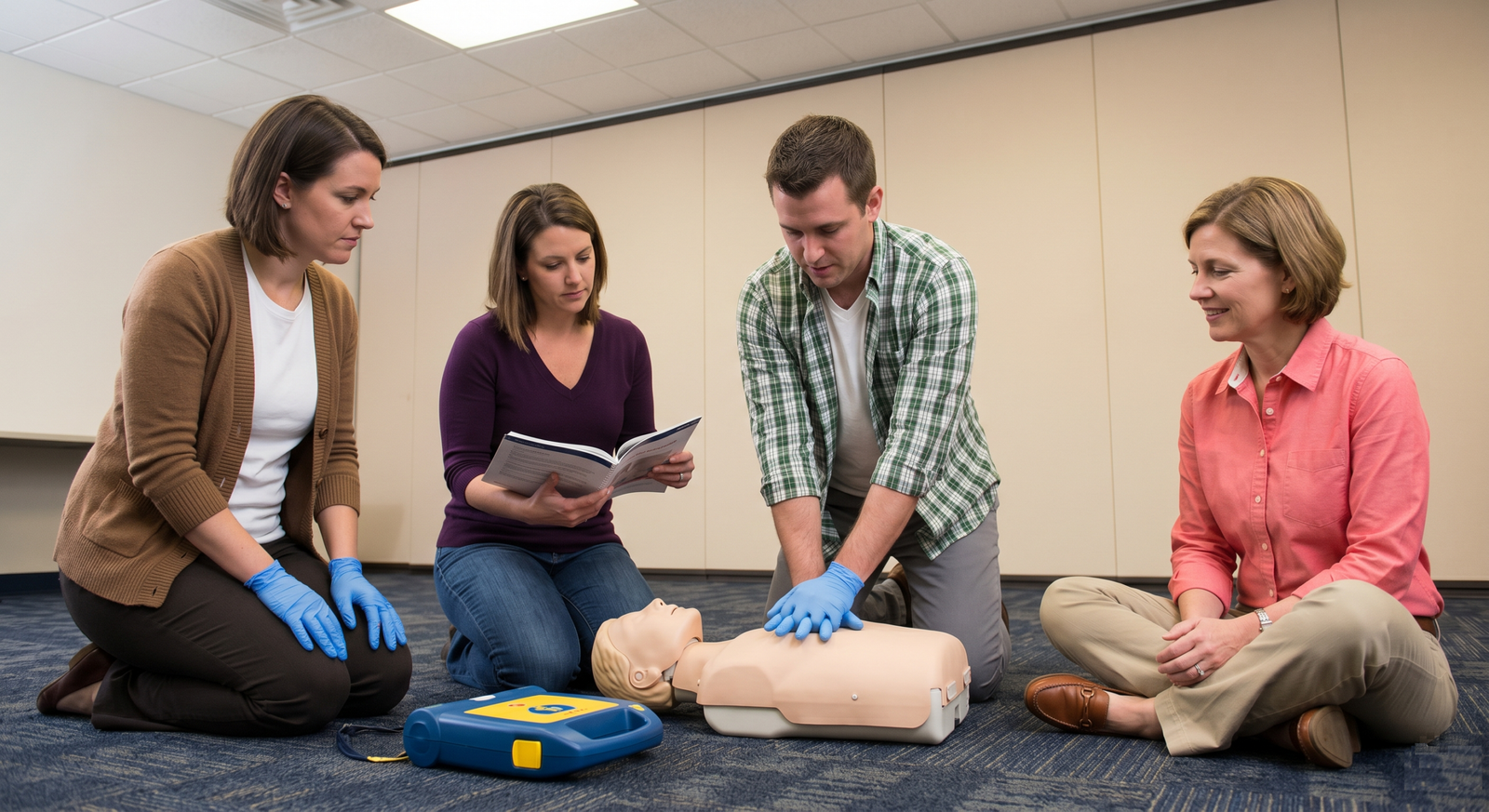
The Emergency First Response course is divided into two main hands-on modules: Primary Care (CPR) and Secondary Care (First Aid). You will learn how to handle life-threatening situations first, before moving on to managing less critical injuries and illnesses.
This module teaches you how to respond to immediate, life-threatening emergencies. You will build muscle memory by practicing on professional training mannequins.
🚨 Scene Assessment & Barrier Use: Learn how to quickly scan an accident site for hidden dangers (like traffic, electricity, or fire) and protect yourself using gloves and ventilation shields before administering care.
🫀 CPR (Cardiopulmonary Resuscitation): Master the correct rhythm, depth, and technique for adult chest compressions and rescue breaths to keep blood flowing to vital organs.
⚡ AED Defibrillator Training: Learn how to confidently set up and operate an Automated External Defibrillator (AED), a smart device that can guide you through restarting a stopped heart.
🩸 Serious Bleeding & Shock Management: Practice applying rapid, heavy pressure bandages to control arterial bleeding and learn how to position a patient to prevent life-threatening medical shock.
🛑 Airway Obstruction (Choking): Master the physical skills required to safely clear a blocked airway for a conscious or unconscious choking adult.
Once a patient is stable, you shift focus to secondary care. This module covers injuries or illnesses that are not immediately life-threatening but require proper treatment and stabilization before paramedics arrive.
🩹 Injury Assessment & Bandaging: Learn how to perform a head-to-toe physical evaluation of a conscious patient, identify hidden traumas, and correctly bandage cuts, scrapes, and burns.
🪵 Splinting Dislocations & Fractures: Practice stabilizing injured limbs or broken bones using everyday items or medical splints so the injury doesn't worsen during transport.
🤒 Illness Assessment: Learn how to recognize the warning signs of serious underlying medical emergencies, such as strokes, heart attacks, severe allergic reactions, diabetic shock, and heatstroke.
Prep: Interactive Home Study (Before the Course): Complete your interactive EFR digital eLearning on your computer or smartphone. Watch the step-by-step tutorial videos and answer the quick quizzes so you understand the basic concepts before arriving.
Step 1: Life Support Practice (1-3 Hours): We gather at our center for a quick theory review. Then, you jump straight into practicing physical skills—including CPR, rescue breathing, airway management, and using our training AED machines.
Step 2: First Aid & Scenarios (3-5 Hours): You will learn bandaging, splinting, and assessment skills. Finally, you will participate in live "emergency roleplay scenarios" where you put everything you've learned together under pressure!
When it comes to learning medical first aid and CPR, the environment and the quality of mentorship make all the difference. At Diving Atlantis, we turn what could be a dry, stressful classroom lecture into an engaging, interactive, and highly practical experience.
Here is why students choose to master their lifesaving skills with our team in Tenerife:
Many people avoid first-aid training because they are afraid of making mistakes or panicking under pressure. Our certified instructors specialize in creating a welcoming, judgment-free space. We don't judge you on perfection from minute one; instead, we give you the space to slow down, practice, make mistakes, and build genuine confidence at your own comfortable pace.
Our team doesn't just read these safety protocols from a textbook—as diving professionals, safety and rescue management are part of our everyday life. We bring real-world context, practical tips, and deep safety insights into every scenario, helping you understand why certain techniques are used rather than just forcing you to memorize them.
Medical terms and emergency protocols can sometimes be confusing in a second language. To make sure you fully comprehend every life-saving technique without any language barriers, we offer the course across multiple languages. You can study your eLearning and practice with instructors in English, Spanish, French, Italian, Polish, or Russian.
We invest in premium training tools to ensure your learning is as close to real life as possible. You will gain hands-on muscle memory practicing on adult CPR mannequins, learning the exact pressure and tempo required for chest compressions. You'll also train with dedicated AED (Automated External Defibrillator) units that simulate real emergency audio coaching.
If you are aiming to become a PADI Rescue Diver, an active EFR certification is a mandatory prerequisite. Completing your EFR training with us at our southern Tenerife center ensures a seamless transition. We can coordinate your land-based safety drills with your ocean rescue sessions, allowing you to complete both certifications over one cohesive, action-packed holiday trip.
Check out the article in our blog about EFR training with us: The Lifesaving Travel Pack: Why Every Adventurous Parent Needs EFR Training
EFR gives you a rock-solid foundation in civilian medical response, opening doors to advanced recreational safety qualifications, emergency leadership roles, and professional opportunities.
Here are the paths you can take after earning your EFR certification:
If you are a scuba diver, your EFR certification is the primary golden key needed to enroll in the PADI Rescue Diver course. While EFR teaches you how to handle medical emergencies on land, the Rescue Diver program teaches you how to adapt those exact skills to dynamic aquatic environments—learning how to handle panicked divers at the surface, manage missing diver searches, and perform in-water rescue breathing.
An active EFR certification (completed within the last 24 months) is a strict mandatory prerequisite to begin your journey as a dive professional. If your dream is to lead dive tours, assist instructors with students, and work at beautiful holiday resorts worldwide, the PADI Divemaster course is your next major goal. Your strong foundation in first aid will give you the confidence needed to supervise dive activities and manage safety logistics as an elite ocean leader.
Not at all! This is a completely land-based, dry course. There is no water work involved whatsoever. The EFR course is a general, internationally recognized CPR and first-aid qualification. It is highly popular among divers, but it is equally open to non-diving family members, teachers, parents, fitness trainers, or anyone wanting to learn how to save a life.
The core EFR course focuses on adult patient care. However, if you are a parent, school teacher, or caregiver, you can ask our team to add the EFR Care for Children module. This add-on teaches you the critical differences in compression techniques, choking management, and rescue patterns specifically required for infants and children under 12.
Yes. The Emergency First Response curriculum is based on the consensus guidelines of the International Liaison Committee on Resuscitation (ILCOR) and meets the standards of major workplace health and safety boards globally. It is widely accepted across many industries (such as corporate offices, childcare, school environments, and guiding industries) as a valid first-aid credential.
Your international EFR certification is valid for 24 months (2 years) from the date of completion. Because medical guidelines evolve and physical muscle memory fades over time, you will need to complete a short, hands-on «EFR Refresher» course every two years to maintain an active status.
Yes, it is a strict requirement. To be certified as a PADI Rescue Diver, you must have completed a recognized Primary and Secondary Care course within the past 24 months. You can easily book your EFR day directly before your Rescue Diver ocean sessions with us here in Tenerife to tick both boxes at once.
Yes, there is a straightforward multiple-choice quiz at the end of your study materials. However, there is no need to stress! The quiz is simply designed to ensure you understand the core concepts (like the correct order of emergency steps). The main focus of the course is on your hands-on physical practice, not intense academic testing.
No. For hygiene and safety reasons, you will never perform rescue breaths on another person during class. You will practice rescue breathing and chest compressions exclusively on sanitized, professional CPR training mannequins. When practicing on fellow students (for skills like bandaging, splinting, or illness assessments), you will use protective gloves and sanitary barriers.
There is no official minimum age limit for the EFR course. The main requirement is that the student must be physically strong enough to compress a adult CPR mannequin’s chest to the proper depth and have the maturity to understand the concepts. We regularly certify teenagers and find it is an incredible confidence-builder for young people!
Because you complete your foundational theory at your own pace ahead of time using the digital PADI eLearning platform, our practical session in Tenerife is highly streamlined. The hands-on practice, scenario roleplay, and skills assessments typically take about 4 to 5 hours (usually a single half-day morning or afternoon session).
EFR follows the exact same international medical protocols used by organizations like the Red Cross, St. John’s Ambulance, and the American Heart Association. The primary difference is the teaching philosophy. EFR is structured to be exceptionally low-stress, focusing on building the confidence of lay-person responders so they are willing to step forward and help rather than freezing up.