
 EN
EN  ES
ES  DE
DE  FR
FR  PL
PL  IT
IT  RU
RU  PT
PT PADI Rescue Diver Course Structure: The Blueprint of a Lifesaver
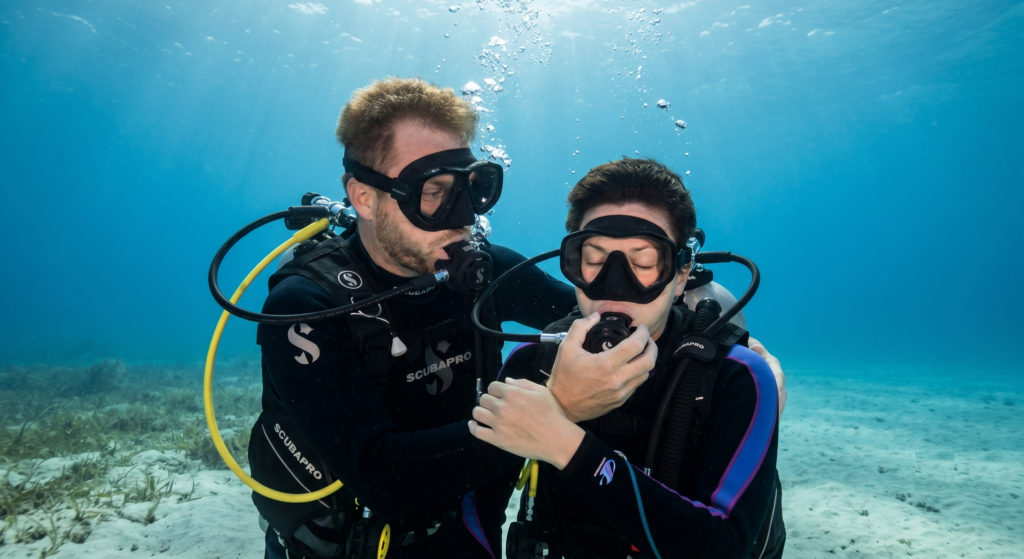
The PADI Rescue Diver course bridges the gap between basic diving skills and complete situational authority. The training is structured to build your confidence progressively: you will start by mastering self-rescue, move on to isolated rescue techniques, and finish by managing complex, full-scale emergency simulations.
🩹 Stage 1: Independent E-Learning (At Your Own Pace)
Before you ever pull on a wetsuit, you will complete the foundational theory using the interactive PADI digital eLearning app on your phone, tablet, or laptop.
-
What you learn: The psychology of rescue, how to spot diver stress, managing equipment malfunctions, executing search patterns for missing divers, and setting up emergency oxygen equipment.
-
The Benefit: You get all the academic quizzes and theory out of the way at home, leaving our time in Tenerife 100% focused on active ocean diving.
🌊 Stage 2: The 10 Core Rescue Exercises (Skill Building)
Once at the dive center, we hit the water to break down and practice the 10 vital physical rescue protocols. You will practice these repeatedly until the physical mechanics become instinctual.
-
Exercise 1: Self-Rescue Review – Managing your own cramps, vertigo, out-of-air emergencies, and equipment entanglements underwater.
-
Exercise 2: Tired Diver – Approaching, stabilizing, and assisting a fatigued diver on the surface who is too exhausted to swim.
-
Exercise 3: Panicked Diver – Safely approaching a frantic, thrashing diver at the surface, executing escape releases if they grab you, and establishing their positive buoyancy.
-
Exercise 4: Distress from Shore/Boat – Assisting an active victim from land or the dive boat using non-swimming assists (throw-lines, reaching extensions).
-
Exercise 5: Unconscious Diver Underwater – Locating and safely ascending with an unresponsive diver without risking your own safety or ascent rate.
-
Exercise 6: Unresponsive Diver at the Surface – Checking for breathing, opening the airway, stripping heavy gear, and initiating in-water rescue breathing while actively towing the victim.
-
Exercise 7: Exiting the Diver – Safely extracting a heavy, non-breathing patient out of the water onto a rocky shoreline or up a steep boat ladder.
-
Exercise 8: First Aid & Oxygen Administration – Setting up demand-valve oxygen delivery systems and treating dive-specific injuries like decompression sickness.
-
Exercise 9: Search for a Missing Diver – Deploying rapid underwater search patterns (U-patterns and expanding squares) using a compass under tight time constraints.
-
Exercise 10: Response from Boat/Shore – Managing an active emergency scene, delegating tasks to bystanders, and coordinating with local emergency medical services (EMS).
🎭 Stage 3: The Final Open Water Rescue Scenarios (The Ultimate Test)
This is where everything you have learned comes together. On the final day of the course, our instructors step back and become actors in live, unscripted simulation drills.
